

Dear QF Community,
We thought some of you might find the newly accepted ICML 2026 paper below interesting. It gives a concrete example of how Lie groups arise in modern machine learning, and why we place so much emphasis on the subject in our specialisation programme at QF Academy.
Symmetry can make machine-learning models more efficient and data-efficient, but in most applications the relevant symmetry is assumed to be known in advance. In practice, it may be unknown, only approximate, or specific to the domain.
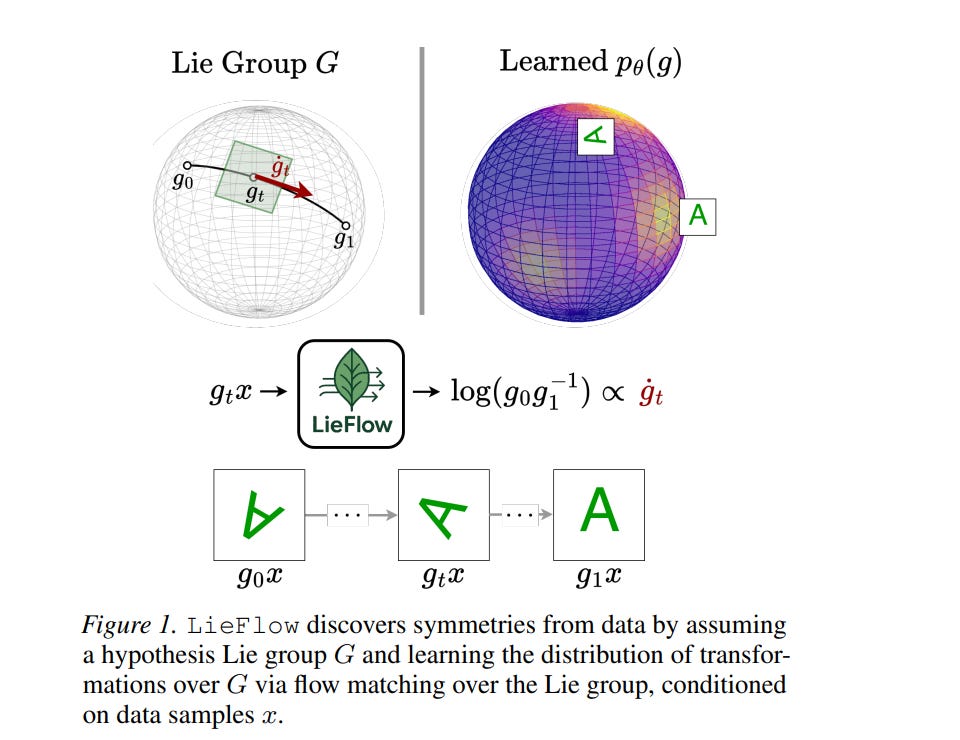
The paper introduces LieFlow, a method for discovering symmetries directly from data. Instead of attempting to estimate symmetry generators alone, it uses flow matching to learn a distribution of candidate transformations within a larger hypothesis Lie group. The transformations that consistently preserve the data distribution emerge as the learned symmetry structure.
A particularly interesting aspect is that the framework can handle both continuous and discrete symmetries. The authors report strong results on synthetic 2D and 3D data, ModelNet10 objects, and human-motion data, where the method identifies an approximate four-fold rotational symmetry without one being imposed in advance. On several discrete-symmetry benchmarks, it substantially outperforms earlier approaches.
We have reached out to the authors about giving a webinar talk for the QF community and will keep you posted. In the meantime, the paper and code are well worth exploring.
Project page: https://jypark0.github.io/lieflow/
We often tell QF Academy students that learning Lie theory is a bit like learning to work with symmetry as a programming toolkit. It helps you identify the transformations that leave the important part of a problem unchanged. Once those are clear, a problem that first looks messy can often become much simpler. That is one reason Lie theory appears everywhere in physics.
Curiosity note: did you know that Lie groups sit at the heart of the Standard Model of particle physics? Its gauge symmetries are described by the group:
To explore Lie groups through applications in machine learning and quantum computing, take a look at the project-based syllabus for QF Academy’s Lie Groups with Applications specialisation programme.
Wishing you all a wonderful rest of the week ahead.
Quantum Formalism team